
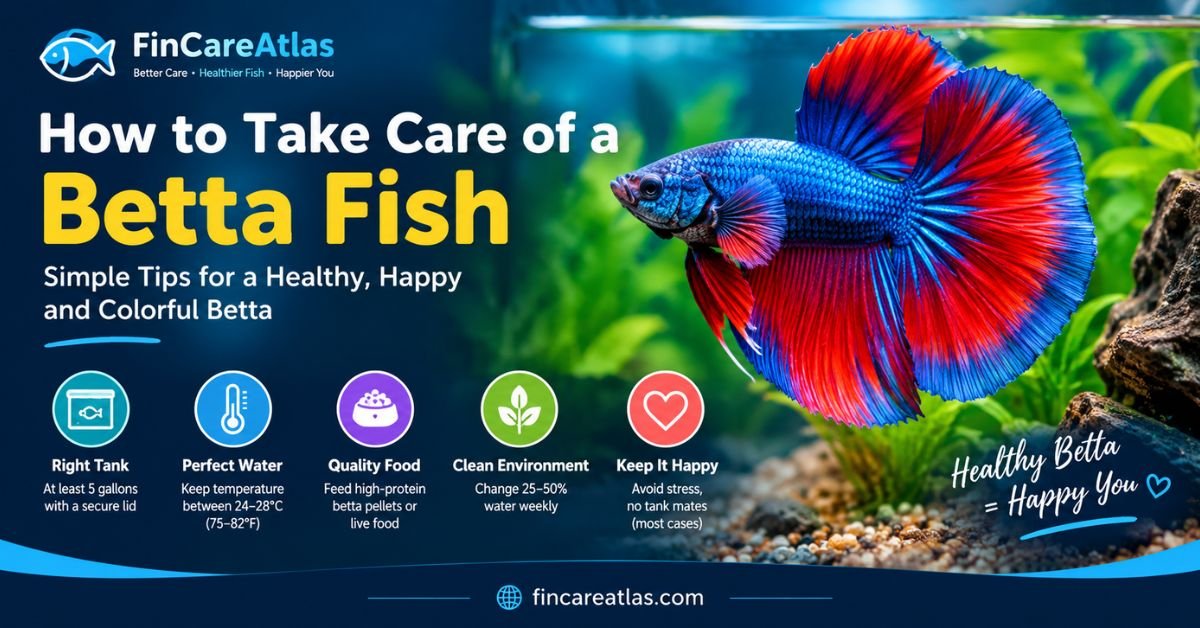
How to Take Care of a Betta Fish: Easy Steps for Beginners
Quick Answer
To take care of a betta fish, keep it in a heated (about 76–82°F / 24–28°C), filtered, fully cycled tank of at least 5 gallons (19 L) with a lid and gentle water flow. Feed small portions of quality betta pellets once or twice daily, do partial water changes weekly with dechlorinated water, and keep it away from fin-nipping tank mates.
Why bettas are easy to buy and surprisingly easy to get wrong
Bettas are sold in cups, tiny vases, and “desktop kits,” and the marketing quietly suggests they need almost nothing. They do not. A betta is a tropical fish that needs warmth, clean water, room to move, and a calm environment, just like most fish people keep.
The confusion has a biological root. Bettas belong to a group called labyrinth fish, which can gulp air from the surface through a special breathing organ. That ability helped them survive in shallow, oxygen-poor water. It is also why people assume they can live in a bowl. Breathing air is not the same as thriving in cold, dirty, cramped water.
This guide walks you through what a betta actually needs and how to set it up. It also covers feeding, weekly routines, tank mates, and the early warning signs of illness, so you can keep one healthy for years instead of months.
Know your fish first
Betta splendens, the Siamese fighting fish, comes from Southeast Asia. Betta have been selectively bred for their fighting ability for hundreds of years, which produced the species’ characteristic male aggression, and more recently for color, fin shape, and body size.
- Adult size: most bettas reach about 2.5–3 inches (6–7.5 cm) in body length. Long fins make them look bigger.
- Lifespan: commonly quoted as roughly 3–5 years with good care. Fish bought from retailers are often already several months old, and individual lifespans vary.
- Temperament: males are territorial and should not share a tank with other males. Females are generally less aggressive but are not automatically peaceful.
- Personality: individuals differ a lot. Some are bold and interactive, others are shy or easily stressed.
Bettas are also not a “no-maintenance” fish. They are a small fish with fairly specific needs, and the beginner’s job is to meet those needs consistently.
Choose the right tank
How big should a betta tank be?
You will see different minimums in published guidance. One major retailer lists 3+ gallons, while another aquarium-hobby guide recommends a minimum of five gallons. Rather than pick the lowest number,
| Tank size | What it means in practice |
|---|---|
| Under 2.5 gal (9 L) | Hard to keep warm and clean; swings in temperature and ammonia are common. Not recommended. |
| 3 gal (11 L) | Workable for an experienced keeper with a heater, a gentle filter, and strict routines. Little margin for error. |
| 5 gal (19 L) | A sensible beginner minimum. More stable, easier to heat, and room for plants and décor. |
| 10 gal (38 L) | More forgiving and gives you more options, including limited tank mates for a suitable betta. |
Larger water volume dilutes waste and changes temperature more slowly, which is why bigger tanks are easier, not harder. A tall, narrow tank is less useful than one with a wider footprint, since bettas swim horizontally and need easy access to the surface.
Essential equipment
- A lid or tight cover. Bettas can and do jump. Leave a small gap for air, because they breathe at the surface.
- A heater with a thermostat. Room temperature is often too cool, and it swings between day and night. Choose a heater suited to your tank volume.
- A thermometer. Do not trust the heater dial alone.
- A gentle filter. Sponge filters are popular because they offer mild flow. A hang-on-back filter can work if you baffle the outflow. Long-finned bettas struggle in strong currents.
- A water conditioner. Tap water usually contains chlorine or chloramine, which harm fish.
- A liquid test kit. It lets you check ammonia, nitrite, and nitrate.
- A soft substrate and smooth décor. Rough plastic plants and sharp ornaments can tear delicate fins.
A simple fin check: drag a pair of tights or a thin stocking across any decoration. If it snags, a betta’s fins probably will too.
Set up and cycle the tank before the fish arrives
The most common beginner mistake is adding the fish the same day the tank is filled. New tanks have no bacteria to process fish waste, so ammonia accumulates quickly. This is called “new tank syndrome,” and it is a leading cause of early betta deaths.
Cycling means building up beneficial bacteria that convert ammonia to nitrite and then to the much less harmful nitrate. One hobby guide stresses that the tank should complete a cycle before the betta is added.
- Set up the tank, filter, and heater, and treat the water with conditioner.
- Add a source of ammonia (pure ammonia product designed for aquariums, or a bottled bacteria starter that explains its own dosing).
- Test every few days. Ammonia and then nitrite will rise and fall.
- The tank is cycled when it can process your ammonia dose to 0 ppm of ammonia and 0 ppm of nitrite within about 24 hours, leaving some nitrate.
- Do a water change to lower nitrate, then add your fish.
This can take roughly 3–6 weeks, sometimes longer, and heated tanks tend to cycle faster. Live plants can help absorb nitrogen compounds but do not replace the cycle.
If you already own a betta in an uncycled tank, don’t panic. Test daily and do water changes as needed to keep ammonia and nitrite as close to zero as possible while the filter matures.
Water conditions: the numbers that matter
Water quality is the single biggest factor in betta health. Published ranges differ slightly. One guide gives 74–81°F, while another gives 76–82°F. A target of about 78–80°F (25.5–27°C), held steady, sits comfortably inside both.
| Parameter | Practical target | Notes |
|---|---|---|
| Temperature | 76–82°F (24–28°C) | Stability matters as much as the number. |
| Ammonia | 0 ppm | Any detectable level is a warning sign. |
| Nitrite | 0 ppm | Same as above. |
| Nitrate | As low as practical (many keepers aim below about 20 ppm) | Rises between water changes. |
| pH | Roughly 6.5–7.5 for most tap water | A stable pH is better than chasing a “perfect” one. |
| Hardness | Soft to moderately hard | Local tap water varies widely. |
Avoid pH-adjusting chemicals unless you know your water is outside a safe range. Repeated adjustments cause swings that stress fish more than a slightly “imperfect” but stable pH.
Decorating the tank so the betta actually uses it
Bettas live in vegetation-rich shallows in the wild, and they behave more naturally when the tank offers cover and resting places.
- Plants: live plants such as java fern, anubias, or floating plants add cover and use up some waste. Silk plants are a good alternative to hard plastic.
- Surface access: bettas need air access, so never cover the entire water surface with a tight decoration or plants. Leave open water at the top.
- Hiding spots: a cave or driftwood arch gives your betta somewhere to retreat.
- Resting places: some keepers add a large leaf or a “betta hammock” near the surface so the fish can rest. Make sure it is smooth and clean.
- Lighting: use a regular day-night cycle of about 8–10 hours of light. Constant light stresses fish and encourages algae.
What to feed a betta
Bettas are mainly insect-eating fish. A good staple is a high-quality betta pellet or small floating pellet with fish or insect protein near the top of the ingredients list. Many keepers rotate in frozen or freeze-dried foods such as bloodworms, brine shrimp, or daphnia a few times a week.
How much? Overfeeding is a classic cause of bloating, constipation, and fouled water. A betta’s stomach is roughly the size of its eye, and portions should be correspondingly small:
- Feed about 2–4 small pellets, once or twice a day, depending on pellet size and the fish’s response.
- Remove any uneaten food after a few minutes.
- Some keepers skip one feeding day per week to give the digestive system a break. This is an optional practice rather than a requirement.
- Soak dry pellets briefly before feeding if your betta tends to bloat. Hobby opinions differ here, so watch your own fish.
Avoid flakes as the only food, since they lose nutrition quickly and often contain more filler. Never feed human food or “betta treats” in large amounts.
Your weekly and daily routine
Consistency beats intensity. Here is a simple routine that works for most 5-gallon setups:
Daily (2–3 minutes)
- Check the thermometer.
- Feed small portions.
- Look at your betta’s color, fins, swimming, and appetite.
Weekly (15–20 minutes)
- Test ammonia, nitrite, and nitrate.
- Do a partial water change. One betta guide suggests 20–30% weekly, and other sources give ranges up to 50% depending on tank size and stocking.
- Use dechlorinated water that is close to tank temperature.
- Gently vacuum debris from the substrate.
- Wipe algae from the glass.
Monthly
- Rinse filter media in old tank water (the water you just removed), never under the tap. Chlorine can kill the bacteria that keep the tank cycled.
- Replace or trim plants as needed.
- Check heater and thermometer for accuracy.
Do not empty and scrub the entire tank. Doing so removes beneficial bacteria and puts your betta through a stressful change.
Tank mates: possible, but not guaranteed
Whether a betta can live with other animals depends on the individual fish and the tank. Compatibility is very betta-dependent: a calm one may coexist with several species, while an aggressive one may harass anything in sight.
General guidelines:
- Never house two male bettas together. One will be seriously injured.
- Avoid fin-nippers such as many barbs, and avoid brightly colored, long-finned fish like fancy guppies, which bettas may treat as rivals.
- Consider quiet bottom-dwellers or snails in a 10-gallon or larger tank. Some bettas ignore them, others attack.
- Have a backup plan. Keep a spare container or divider ready so you can separate fish at the first sign of persistent aggression.
- Skip tank mates in small tanks. A 5-gallon is usually better kept as a single-betta home.
Female “sorority” tanks are an advanced setup and are not recommended for beginners. They need larger tanks, dense planting, and close monitoring.
Recognizing common problems early
Healthy bettas are alert, eat eagerly, have intact, spread fins, and respond to movement outside the tank. Warning signs include:
- Clamped fins held tightly against the body
- Lethargy or sitting on the bottom for long periods
- Loss of appetite
- Faded color or a stringy, dull look
- Frayed, shortened, or darkening fin edges
- White specks on the body or fins
- A swollen belly or visible scales sticking out
- Rapid gill movement or gasping at the surface
Common causes
- Poor water quality or temperature stress causes many problems. Test your water first, since this is the most common underlying issue.
- Fin rot often appears as ragged fin edges and is frequently linked to poor water conditions.
- Ich (white spot disease) shows as small white dots. Treatment requires following the specific product directions and a stable, appropriate temperature.
- Bloating and constipation often relate to overfeeding or diet.
- Fungal or bacterial infections can be hard to tell apart visually.
Symptoms overlap, so you cannot reliably diagnose a fish by appearance alone. Start by testing water and correcting problems. If symptoms persist or worsen, or if more than one fish is affected, consult an aquatic veterinarian or a qualified fish-health professional. Use medications only according to the label, and be aware that some medications harm snails, plants, or filter bacteria.
7 Common mistakes to avoid
- Keeping a betta in a bowl, vase, or cup. These are hard to heat, filter, and keep clean.
- Skipping the cycle. Fish added to a fresh tank are exposed to ammonia.
- Using a strong filter without baffling it. Torn fins and exhaustion are common results.
- Overfeeding. More food does not equal a happier fish.
- Changing all the water at once. Large, sudden changes stress bettas and remove helpful bacteria.
- Ignoring the thermometer. An unheated tank can run well below a betta’s comfort range.
- Adding fish to “keep it company.” Bettas are not schooling fish and do not need companions.
Conclusion
Learning how to take care of a betta fish comes down to getting the foundation right: a properly sized, heated, filtered, and cycled tank, small portions of suitable food, and a steady routine of water testing and partial changes. When those basics are in place, most betta problems never start, and the fish can show the curiosity and personality that make them so appealing.
Your next step is practical: before buying the fish, set up the tank and begin cycling it, and buy a liquid test kit and a thermometer. Once your betta is home, check the temperature and watch its behavior daily, and test the water weekly. If something looks wrong, test the water first, correct what you find, and contact an aquatic veterinarian if the fish does not improve.
Explore More Continue Reading Our Guide on: Fincareatlas.com
Frequently Asked Questions
1: Can a betta live in a small bowl without a filter or heater?
It may survive for a while, but survival is not the same as good welfare. Small, unheated, unfiltered containers swing in temperature and build up waste quickly. A heated, filtered tank of about 5 gallons or more is a much better standard.
2: How often should I feed my betta?
Usually once or twice daily in very small amounts, whatever the fish finishes within a couple of minutes. Adjust if your betta looks bloated or leaves food behind.
3: Do bettas get lonely?
There is no evidence that bettas need companions. They are typically kept alone, and the main risk with tank mates is stress and aggression, not loneliness. Enrichment such as plants, cover, and a stable routine matters more.
4: Why is my betta lying on the bottom or at the top of the tank?
Possible causes include cold water, poor water quality, old age, swim bladder problems, or simple resting. Check temperature and test ammonia, nitrite, and nitrate first. If the behavior continues with other symptoms, seek professional advice.
5: How long do betta fish live?
Often around 3–5 years with good care, though results vary. Genetics, age at purchase, and water quality all influence lifespan.
6: Do bettas need a lid?
Yes. They can jump, so a lid with a small air gap helps prevent accidents while still allowing surface breathing.